
Archaeology.Today
Field Report

Medieval Silver Hoard in Kolomna May Belong to Plague Victim

Archaeologists in Kolomna, southeast of Moscow, have uncovered a ceramic jug containing about 2,600 medieval silver coins. More than 350 appear to be previously unknown varieties, while the hoard’s latest coins may connect its burial with a plague epidemic that affected Russian principalities from 1424 to 1427.

September 7, 2026
1 Source
Medieval Silver Hoard in Kolomna May Belong to Plague Victim
The Story

Archaeologists have discovered a medieval hoard of approximately 2,600 silver coins in the historic center of Kolomna, about 114 kilometers southeast of Moscow. The coins were placed in an elegant ceramic jug and buried in a pit.

The find was reported by Live Science, citing a translated statement from the Institute of Archaeology of the Russian Academy of Sciences. Most of the coins are dengas, a denomination first minted in the late 14th century by the Grand Principality of Moscow. A denga was worth half a kopek, and 100 kopeks made a ruble.

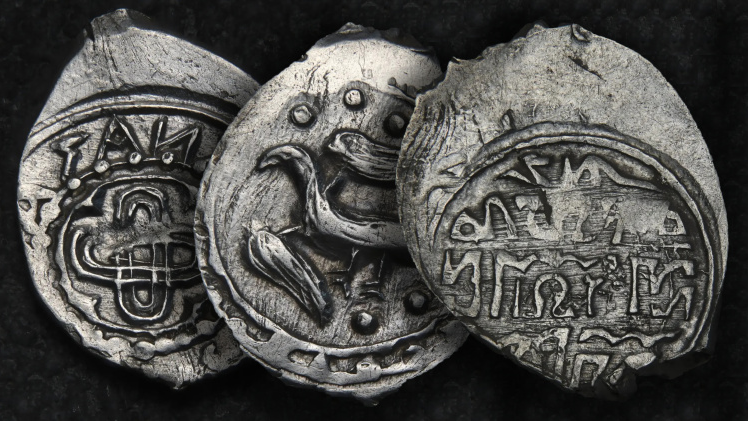
The hoard is largely made up of coins minted in Kolomna during the reigns of Vasily I, who ruled from 1389 to 1425, and Vasily II, who ruled from 1425 to 1462. One especially rare example bears the image of a bird in flight and was produced during the final years of Vasily I’s reign.

More than 350 coins represent varieties that experts had not previously documented. Researchers are continuing to study those coins, which may provide additional information about medieval minting in Kolomna.

The size of the hoard and its contents suggest that the person who buried it was probably wealthy and held high social status. The Institute of Archaeology said the owner may have been a senior government official or a highly successful merchant, although the individual’s identity is unknown.

The reason for hiding the coins is also uncertain. The newest coins date to the second half of the 1420s, and researchers believe that timing may be significant. A plague epidemic swept through the Russian principalities between 1424 and 1427, raising the possibility that the hoard’s owner died during the outbreak or was otherwise unable to recover the buried money.

That interpretation remains tentative. The evidence establishes when the latest coins were produced, but it does not directly identify the person who concealed them or confirm that the burial was connected to the epidemic.

Reference Desk

Sources & Further Reading

Continue Exploring

Related Archaeology

More stories
More Than 2,600 Medieval Silver Coins Found in Kolomna
01
Artifacts
Score 305

More Than 2,600 Medieval Silver Coins Found in Kolomna

Rescue excavations in Kolomna have uncovered more than 2,600 medieval silver dengi concealed in a ceramic jug. Researchers describe the assemblage as the largest intact Russian coin hoard known from the first half of the 15th century, with rare locally minted coins and previously unknown varieties.

Read story
Excavations Recast the Date of Galich’s Lost Lower Fortress
02
Archaeological Science
Score 125

Excavations Recast the Date of Galich’s Lost Lower Fortress

LiDAR mapping and 2026 excavations at Galich’s Lower Settlement found defensive earthworks and artifacts mainly dating to the 14th and 15th centuries. The evidence challenges its traditional identification as a 12th-century fortress and points instead to construction around the mid-15th century, possibly amid a dynastic conflict.

Read story
Bronze-Casting Mould and Weapons Found at Tatarstan Pyanobor Site
03
Excavations
Score 85

Bronze-Casting Mould and Weapons Found at Tatarstan Pyanobor Site

Excavations at the Kipchak Archaeological Complex in Russia’s Tatarstan have yielded a bronze-casting mould, bronze and iron arrowheads, a spearhead, jewellery and decorated pottery. Kazan Federal University archaeologists say the finds may help investigate the debated origins of the Pyanobor culture.

Read story
Archaeologists Begin New Survey of the 1410 Grunwald Battlefield
04
Discoveries
Score 75

Archaeologists Begin New Survey of the 1410 Grunwald Battlefield

About 40 archaeologists, metal detectorists and museum specialists are surveying previously unexamined areas of Poland’s Grunwald battlefield. The work aims to refine the map of fighting between Polish-Lithuanian forces and the Teutonic Order, building on systematic research conducted since 2014.

Read story
Medieval Deserted Settlement Revealed at Halberstadt Development Site
05
Discoveries
Score 75

Medieval Deserted Settlement Revealed at Halberstadt Development Site

Excavations at Am Frevelgraben, on the eastern edge of Halberstadt in Saxony-Anhalt, have exposed rows of sunken buildings, wells and changing ditch boundaries. The settlement appears to have been abandoned in an unusually orderly way, with residents taking most of their possessions when they left.

Read story
Excavation in Tonnerre Reveals 1,500 Years of Hilltop Settlement
06
Excavations
Score 75

Excavation in Tonnerre Reveals 1,500 Years of Hilltop Settlement

An Inrap excavation on Montbellant hill in northern France has uncovered medieval buildings, Roman-period remains and evidence of a first-century BC Gallic oppidum. The layered site, investigated ahead of house construction, is helping archaeologists trace the development of Tonnerre’s upper town.

Read story