
Archaeology.Today
Field Report

Bedminster Mill Excavation Reveals 170 Years of Industrial Change

Excavations at the former St Catherine’s Place shopping centre in Bristol uncovered substantial remains of Bedminster Mill, including its wheel pit, foundations and evidence of repeated alterations. The mill appears to have adapted from undershot to breast-shot, overshot and eventually steam power as the surrounding population and demand for water grew.

September 8, 2026
1 Source
Bedminster Mill
Bedminster Mill Excavation Reveals 170 Years of Industrial Change
The Story

Excavations at the former St Catherine’s Place shopping centre in Bedminster, Bristol, have revealed substantial remains of a water mill that operated for more than 170 years as the area developed from open fields into an expanding industrial and residential district.

Wessex Archaeology carried out the work in 2023 for Galliard Homes as part of the Land at St Catherine’s Bristol development. The site, between Dalby Avenue and East Street, contained surviving walls from the former Bedminster mill, which appeared on town maps until about 1885. Documentary evidence indicates that the mill was in place by 1712 and appears on all town plans from 1828.

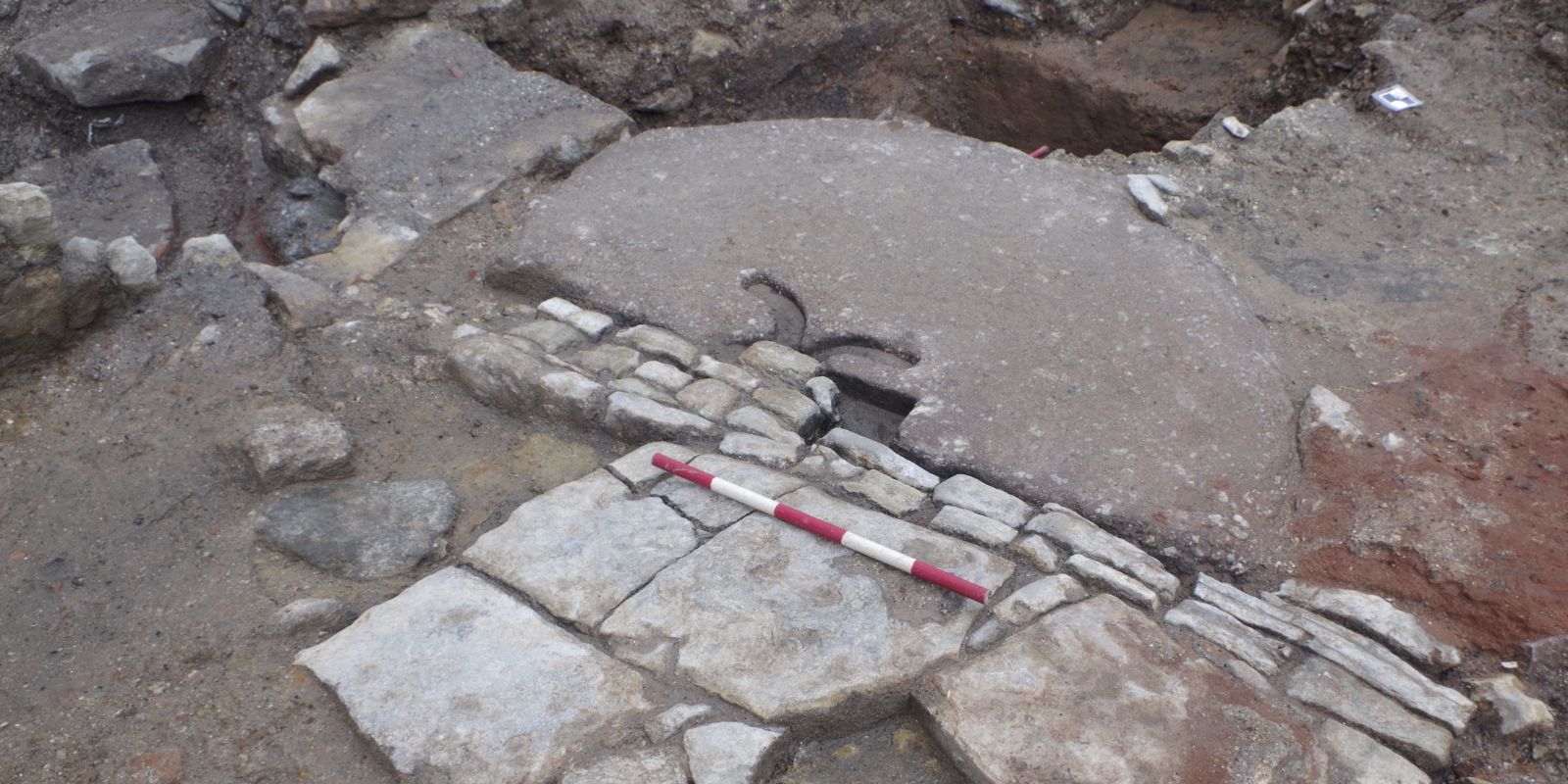
Unlike many former mills, where only the base of a wheel pit survives, the Bedminster site retained numerous walls and other structural remains. Excavators identified a curved stone-lined wheel pit that survived to considerable depth and across its full width. Its dimensions indicated the diameter of the water wheel, while scuff marks were consistent with repeated movement of the wheel in the same position.

The remains suggest that the mill’s power system changed over time. It initially used an undershot wheel, with water entering from below, before being modified for breast-shot operation and later for an overshot wheel, in which water arrived from above. Wessex Archaeology reports that the later arrangement provided greater power as increasing demand for drinking water and industry reduced the supply available from the River Malago. Documentary sources indicate that steam power was used toward the end of the mill’s operation, introducing the additional cost of fuel.

The team also found evidence of repeated rebuilding and repair, with walls replaced or constructed alongside earlier sections. The mill race used pooled water to feed the wheel, while nearby foundations traced buildings along Mill Lane. A cellar had been fitted into a narrow gap between properties, with brick steps cut into the bedrock.

Material recovered from the site included pottery, glass, clay pipes, leather shoes, bottles, shells and household objects such as ink pots and chamber pots. Large quantities of mussel shells in a drain may reflect the sale of mussels collected from local waterways as street food, although this remains an interpretation.

Dumped material used to stabilise the river edge included pottery and glass-production waste dated to 1730–1790. Wessex Archaeology said further specialist research into the remains is continuing.

Reference Desk

Sources & Further Reading

Continue Exploring

Related Archaeology

More stories
Bronze-Casting Mould and Weapons Found at Tatarstan Pyanobor Site
01
Excavations
Score 40

Bronze-Casting Mould and Weapons Found at Tatarstan Pyanobor Site

Excavations at the Kipchak Archaeological Complex in Russia’s Tatarstan have yielded a bronze-casting mould, bronze and iron arrowheads, a spearhead, jewellery and decorated pottery. Kazan Federal University archaeologists say the finds may help investigate the debated origins of the Pyanobor culture.

Read story
Villa Complex and 84-Square-Metre Mosaic Found in Eastern Türkiye
02
Excavations
Score 40

Villa Complex and 84-Square-Metre Mosaic Found in Eastern Türkiye

A farmer’s discovery of mosaic remains in Salkaya village led to excavations revealing a settlement with a villa, bathhouse, church, grain-storage area and child’s grave. Archaeologists date the complex to the Late Roman and Early Byzantine periods, but its original owner remains unknown.

Read story
4,000-Year-Old Geometric Tablet Found at Lake Garda Settlement
03
Excavations
Score 40

4,000-Year-Old Geometric Tablet Found at Lake Garda Settlement

Archaeologists excavating the Early Bronze Age settlement of Lucone D near Italy’s Lake Garda have recovered a clay tablet marked with geometric designs. It is the 21st enigmatic tablet found across the wider Lucone site, but the purpose and meaning of the markings remain unknown.

Read story
Excavations Recast the Date of Galich’s Lost Lower Fortress
04
Archaeological Science
Score 40

Excavations Recast the Date of Galich’s Lost Lower Fortress

LiDAR mapping and 2026 excavations at Galich’s Lower Settlement found defensive earthworks and artifacts mainly dating to the 14th and 15th centuries. The evidence challenges its traditional identification as a 12th-century fortress and points instead to construction around the mid-15th century, possibly amid a dynastic conflict.

Read story
Excavations Trace Centuries of Change Along Side’s 390-Metre Street
05
Excavations
Score 40

Excavations Trace Centuries of Change Along Side’s 390-Metre Street

Archaeologists have completed work on Street B, a nearly 390-metre-long thoroughfare in the ancient city of Side in southern Turkey. The excavation documented a second-century AD colonnade, three monumental entrances and a fifth-century transformation linked to the city’s Bishop’s Palace complex.

Read story
Excavation in Tonnerre Reveals 1,500 Years of Hilltop Settlement
06
Excavations
Score 40

Excavation in Tonnerre Reveals 1,500 Years of Hilltop Settlement

An Inrap excavation on Montbellant hill in northern France has uncovered medieval buildings, Roman-period remains and evidence of a first-century BC Gallic oppidum. The layered site, investigated ahead of house construction, is helping archaeologists trace the development of Tonnerre’s upper town.

Read story