
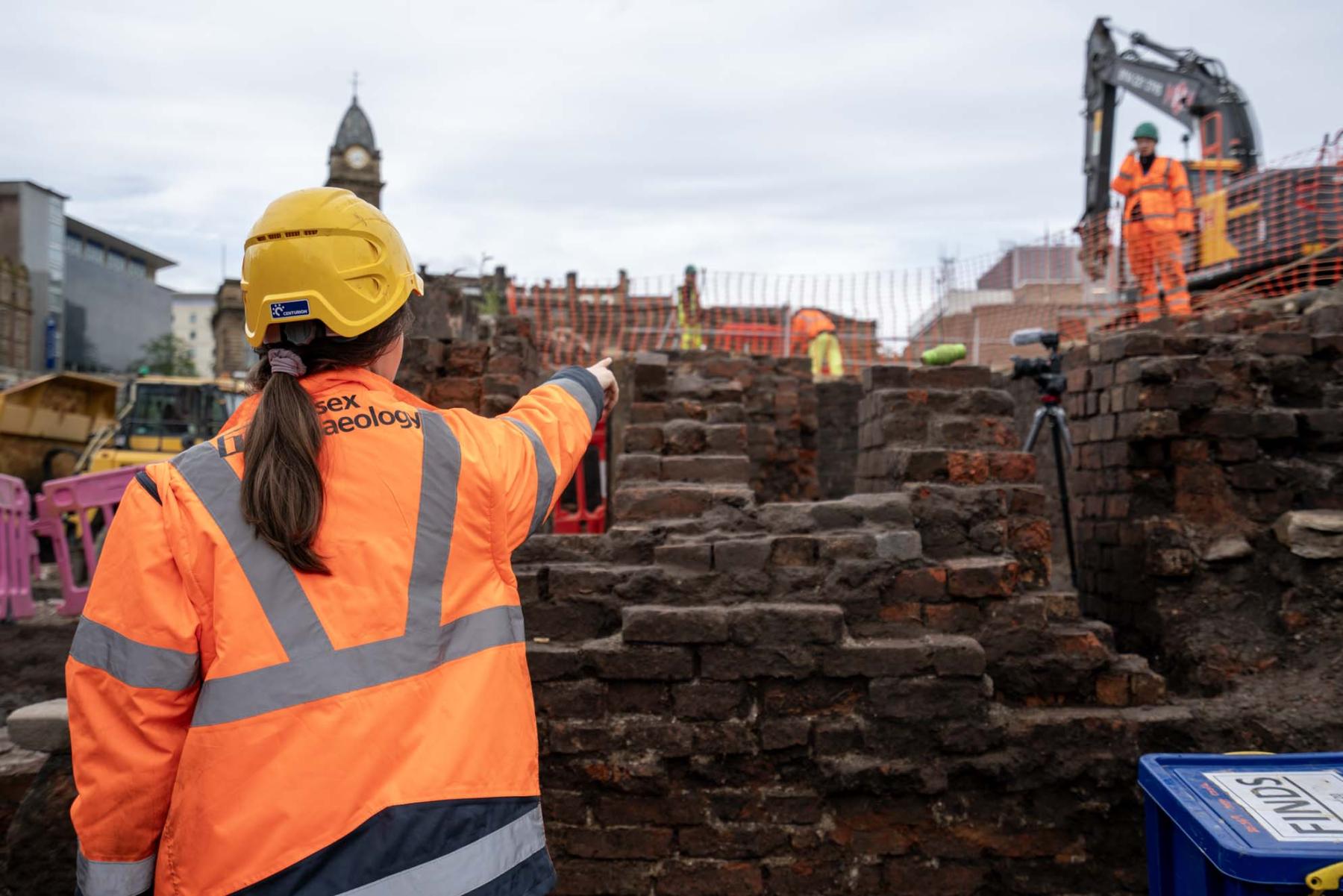
Archaeologists excavating the site of Sheffield Castle have uncovered the remains of a 19th-century crucible furnace, revealing new evidence of steel production on the castle mound.
The 10-week excavation forms part of Sheffield City Council’s Castlegate regeneration project and is overseen by construction engineering specialists Keltbray. The work is also intended to uncover and preserve the castle’s medieval gatehouse. Archaeologists used an 1850s Ordnance Survey map and other research questions to guide their investigation of the site.
After removing modern concrete foundations associated with the former market and deposits of backfill, the team reached a 19th-century archaeological layer. Brick remains, including sections of a vaulted ceiling, led to the identification of a cellar containing a crucible furnace. Rows of brick bays beneath the furnace were interpreted as ash, or “rake out,” pits.
Crucible furnaces were used to refine blister steel into a higher-quality, more homogeneous form of crucible steel. The furnace would have reached temperatures of about 1,200 degrees Celsius and generated ash that had to be removed from the pits below. The excavation also exposed four curved steps descending into the cellar. Although the steps appear on the 1850s map, their surviving form was unexpected because the bottom had been bricked up.
The furnace itself was not shown on the maps consulted by the excavation team. Its discovery indicates that previously undocumented industrial remains survive beneath the castle mound.
During a small deep trial trench through the cellar’s backfill, archaeologist Marijane Porter recorded layers containing waste from the firing process. Near the base of the furnace, the team found numerous pieces of ceramic fused together. A volunteer suggested they could relate to a vent or cowl, but the material has not yet been identified by finds specialists.
The discovery may also help clarify the workflow at the Castle Hill Steel Works. A 2018 trial trench evaluation found parts of a cementation furnace, which would have produced blister steel. The newly identified crucible furnace could therefore have been involved in a later stage of the same production process, although the relationship between the two structures remains an interpretation rather than a confirmed reconstruction.
Archaeologists are continuing to record the furnace before investigating deeper archaeological deposits at the site.


