
Archaeology.Today
Field Report

Sheffield Castle Excavation Reveals Drawbridge Pier and Possible Earlier Phase

Archaeologists excavating Sheffield’s former Castle Market site have uncovered a sandstone drawbridge pier, previously unknown interior walls and a six-metre-deep moat. Finds from the moat may point to an earlier phase of the castle, while archaeomagnetic dating is being used to investigate the age of its defensive mound.

September 8, 2026
1 Source
Sheffield Castle
Sheffield Castle Excavation Reveals Drawbridge Pier and Possible Earlier Phase
The Story

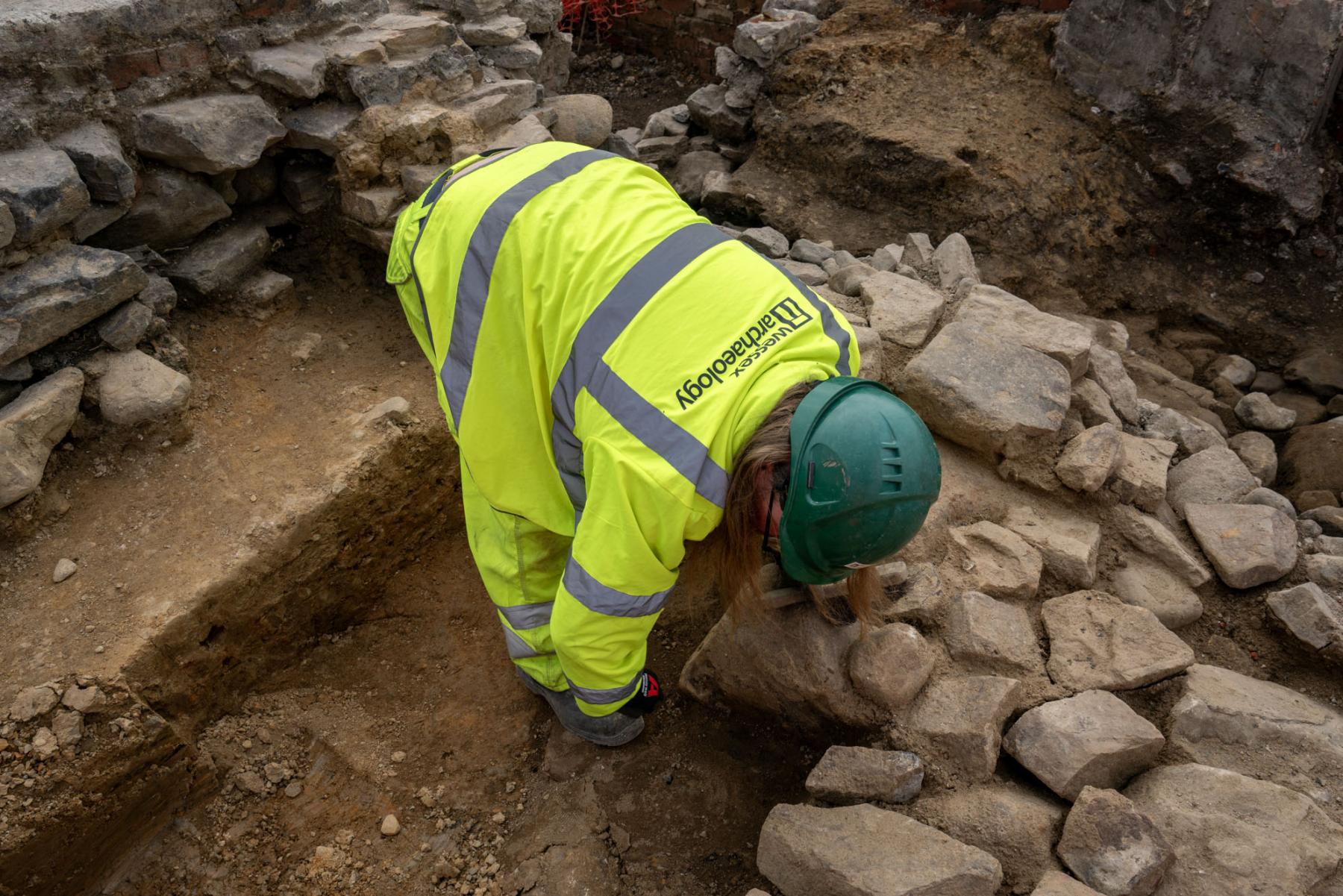
A large-scale excavation at Sheffield Castle has uncovered part of the castle’s drawbridge pier, previously unknown internal walls and evidence that may relate to an earlier phase of the site. The work is taking place at the former Castle Market site as part of Sheffield City Council’s Castlegate regeneration project.

The drawbridge feature is a dressed sandstone platform where the castle’s drawbridge would have rested. Archaeologists from Wessex Archaeology said this is the first time this part of the gatehouse pier has been exposed.

Excavation of the castle’s motte—the manmade defensive mound on which the castle was built—also revealed a series of internal walls. Some are more than 1.5 metres wide. Because no illustrations of the castle survive and documentary references are limited to passing mentions, the walls provide the first tangible evidence reported for the arrangement of the castle’s interior.

The team is using archaeomagnetic dating to establish when the motte was constructed and to investigate the origins of the mound. Work has also exposed the castle’s six-metre-deep moat. Archaeologists say material found there may preserve evidence from before the medieval castle, possibly indicating an earlier castle phase, although that interpretation remains provisional.

Among the moat finds is a mid-16th-century Nuremberg copper-alloy Jetton. The counter would have functioned somewhat like money. Its date places it in the period associated with Mary Queen of Scots’ imprisonment at the castle by her cousin, Queen Elizabeth I, according to Wessex Archaeology.

Ashley Tuck, the archaeologist leading the excavation for Wessex Archaeology, said the newly uncovered walls add to the emerging picture of the castle during its period as a medieval centre of power. He also described the moat evidence as possibly connected with an undocumented earlier phase.

The excavation is overseen by construction engineering specialists Keltbray and is described as the first large-scale professional excavation conducted at the site. Earlier building work exposed parts of the castle in the 1920s and during reconstruction after the Second World War. Wessex Archaeology also carried out trial excavation there in 2018, but the current project is the first to systematically investigate large areas using modern archaeological methods and scientific techniques.

Reference Desk

Sources & Further Reading

Continue Exploring

Related Archaeology

More stories
Excavations Recast the Date of Galich’s Lost Lower Fortress
01
Archaeological Science
Score 95

Excavations Recast the Date of Galich’s Lost Lower Fortress

LiDAR mapping and 2026 excavations at Galich’s Lower Settlement found defensive earthworks and artifacts mainly dating to the 14th and 15th centuries. The evidence challenges its traditional identification as a 12th-century fortress and points instead to construction around the mid-15th century, possibly amid a dynastic conflict.

Read story
Excavation in Tonnerre Reveals 1,500 Years of Hilltop Settlement
02
Excavations
Score 95

Excavation in Tonnerre Reveals 1,500 Years of Hilltop Settlement

An Inrap excavation on Montbellant hill in northern France has uncovered medieval buildings, Roman-period remains and evidence of a first-century BC Gallic oppidum. The layered site, investigated ahead of house construction, is helping archaeologists trace the development of Tonnerre’s upper town.

Read story
Archaeologists Begin New Survey of the 1410 Grunwald Battlefield
03
Discoveries
Score 75

Archaeologists Begin New Survey of the 1410 Grunwald Battlefield

About 40 archaeologists, metal detectorists and museum specialists are surveying previously unexamined areas of Poland’s Grunwald battlefield. The work aims to refine the map of fighting between Polish-Lithuanian forces and the Teutonic Order, building on systematic research conducted since 2014.

Read story
Medieval Deserted Settlement Revealed at Halberstadt Development Site
04
Discoveries
Score 75

Medieval Deserted Settlement Revealed at Halberstadt Development Site

Excavations at Am Frevelgraben, on the eastern edge of Halberstadt in Saxony-Anhalt, have exposed rows of sunken buildings, wells and changing ditch boundaries. The settlement appears to have been abandoned in an unusually orderly way, with residents taking most of their possessions when they left.

Read story
More Than 2,600 Medieval Silver Coins Found in Kolomna
05
Artifacts
Score 75

More Than 2,600 Medieval Silver Coins Found in Kolomna

Rescue excavations in Kolomna have uncovered more than 2,600 medieval silver dengi concealed in a ceramic jug. Researchers describe the assemblage as the largest intact Russian coin hoard known from the first half of the 15th century, with rare locally minted coins and previously unknown varieties.

Read story
Bronze-Casting Mould and Weapons Found at Tatarstan Pyanobor Site
06
Excavations
Score 40

Bronze-Casting Mould and Weapons Found at Tatarstan Pyanobor Site

Excavations at the Kipchak Archaeological Complex in Russia’s Tatarstan have yielded a bronze-casting mould, bronze and iron arrowheads, a spearhead, jewellery and decorated pottery. Kazan Federal University archaeologists say the finds may help investigate the debated origins of the Pyanobor culture.

Read story