Archaeology.Today
Field Report

Roman Villa Mosaic at Adramytteion Depicts Named Cat and Dog

Archaeologists excavating the ancient city of Adramytteion in Turkey uncovered a multicolored Roman mosaic featuring 15 panels of animals and mythological figures. Two animals are labeled in Greek as Emerald, a seated cat, and Ocean, a running or leaping dog.

September 6, 2026
1 Source
Adramytteion
Roman Villa Mosaic at Adramytteion Depicts Named Cat and Dog
The Story

Archaeologists have uncovered a large Roman-era floor mosaic in a villa at Adramytteion, an ancient city on Turkey’s Aegean coast. The mosaic includes 15 panels depicting animals and mythological figures, including a cat and a dog identified by Greek inscriptions as Emerald and Ocean.

According to Live Science, the villa was excavated in 2025 and early 2026 by a team led by Hüseyin Özgen of Mimar Sinan Fine Arts University. The residence dates to the late second to third centuries A.D. and included three halls arranged around a central atrium, along with additional rooms and a system of pipes and drains that may have served a latrine.

The mosaic occupied what archaeologists believe was the villa’s main reception hall. Measuring about 16.4 by 11.8 feet (5 by 3.6 meters), it was arranged in three rows and created with tiles in colors including white, black, red, orange, yellow, pink, burgundy, blue, turquoise and green.

Most of the panels show birds, fish and felines. Two others draw on mythology: one appears to show a gorgon, possibly Medusa, while another may depict the winged horse Pegasus. The central image appears to represent Medusa, although the identification remains tentative.

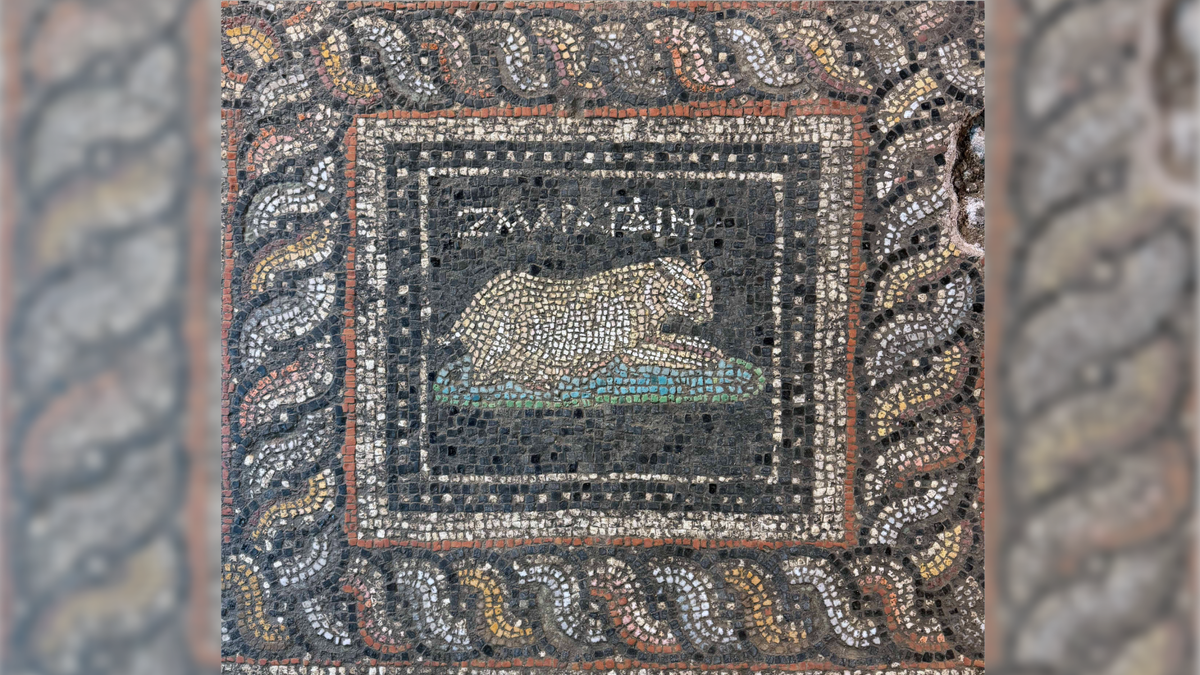
One panel shows a pale cat seated on a blue-green cushion. Greek letters above the animal spell Zmaragdin, meaning “Emerald.” The cat’s relaxed pose and placement on a cushion may indicate that it was a household pet, though researchers say the image could also have represented a familiar animal associated with the residence.

A second labeled panel depicts a running or leaping dog. Its inscription reads Okeanos, meaning “Ocean.” Özgen suggested that the name may have reflected Adramytteion’s setting as a harbor city, but this is an interpretation rather than a confirmed explanation.

In a study forthcoming in the Journal of Mosaic Research, Özgen wrote that Emerald and Ocean may have been familiar to the villa’s residents and that their images could have served as signs of household identity or ownership. Research at Adramytteion is continuing.

Reference Desk

Sources & Further Reading

Continue Exploring

Related Archaeology

More stories
Hadrian Statue Reconstructed from Roman Ruins at Kibyra
01
Artifacts
Score 150

Hadrian Statue Reconstructed from Roman Ruins at Kibyra

Archaeologists in southwestern Turkey have reconstructed a 2.14-meter marble statue of Emperor Hadrian from fragments found at Kibyra’s Monumental Entrance Gate. The excavation also produced remains believed to represent Empress Sabina and other Roman sculptures, many of which may have been shattered by an earthquake in AD 417.

Read story
Villa Complex and 84-Square-Metre Mosaic Found in Eastern Türkiye
02
Excavations
Score 125

Villa Complex and 84-Square-Metre Mosaic Found in Eastern Türkiye

A farmer’s discovery of mosaic remains in Salkaya village led to excavations revealing a settlement with a villa, bathhouse, church, grain-storage area and child’s grave. Archaeologists date the complex to the Late Roman and Early Byzantine periods, but its original owner remains unknown.

Read story
Excavations Trace Centuries of Change Along Side’s 390-Metre Street
03
Excavations
Score 120

Excavations Trace Centuries of Change Along Side’s 390-Metre Street

Archaeologists have completed work on Street B, a nearly 390-metre-long thoroughfare in the ancient city of Side in southern Turkey. The excavation documented a second-century AD colonnade, three monumental entrances and a fifth-century transformation linked to the city’s Bishop’s Palace complex.

Read story
Ancient Sardis Added to UNESCO World Heritage List After Decades of Excavation
04
Heritage
Score 100

Ancient Sardis Added to UNESCO World Heritage List After Decades of Excavation

Sardis, an ancient city in western Turkey excavated continuously since 1958, has been added to the UNESCO World Heritage List. Researchers say the designation recognizes decades of archaeological work while highlighting the need to protect the site from erosion, farming damage and looting.

Read story
2nd-Century Shield Boss With Cremated Remains Found in Polish Scrap Yard
05
Discoveries
Score 75

2nd-Century Shield Boss With Cremated Remains Found in Polish Scrap Yard

A corroded iron shield boss recovered from a scrap yard in Hrubieszów, eastern Poland, has been dated to around the 2nd century AD. Museum specialists found cremated human bones inside it, suggesting the object came from a destroyed Przeworsk culture warrior burial, although the individual’s sex cannot be established.

Read story
Archaeologists Begin New Survey of the 1410 Grunwald Battlefield
06
Discoveries
Score 75

Archaeologists Begin New Survey of the 1410 Grunwald Battlefield

About 40 archaeologists, metal detectorists and museum specialists are surveying previously unexamined areas of Poland’s Grunwald battlefield. The work aims to refine the map of fighting between Polish-Lithuanian forces and the Teutonic Order, building on systematic research conducted since 2014.

Read story