
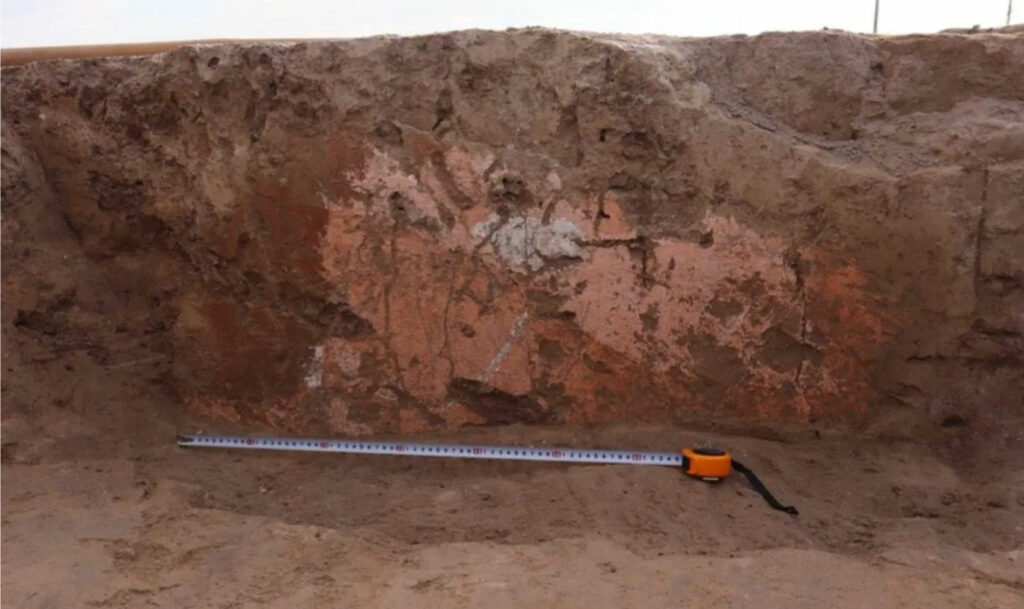
A floral mural has been discovered at the Boburtepa archaeological site in southern Uzbekistan, where researchers are examining a building that may have served as a temple during the fourth and fifth centuries A.D.
According to reporting cited by Archaeology Magazine, the find was made by Sanjar Abdurakhimov of the Institute of Archaeology of Samarkand and his colleagues. The wall decoration was painted onto a layer of clay applied to the building’s wall. It includes tulips and white flowers outlined or embellished with thin, wavy red lines.
The mural was later concealed beneath a layer of white lime plaster. The covering preserved the earlier painted surface, although the supplied report does not describe the mural’s condition, dimensions, or the circumstances of its discovery in greater detail.
Researchers have not yet established the building’s function. It is thought to have been used as a temple, but the team plans further investigation to assess that possible interpretation. The floral imagery therefore documents the building’s decoration, while its precise role remains under study.


