Archaeology.Today
Field Report

Polish Junkyard Find May Be Part of a Vandal Warrior’s Cremation Burial

A man searching for car parts near Hrubieszów found an iron shield boss estimated to be about 1,800 years old. Examination of earth trapped inside revealed cremated bones, leading archaeologists to identify the object as a possible remnant of a Vandal warrior’s burial.

September 1, 2026
1 Source
Polish Junkyard Find May Be Part of a Vandal Warrior’s Cremation Burial
The Story

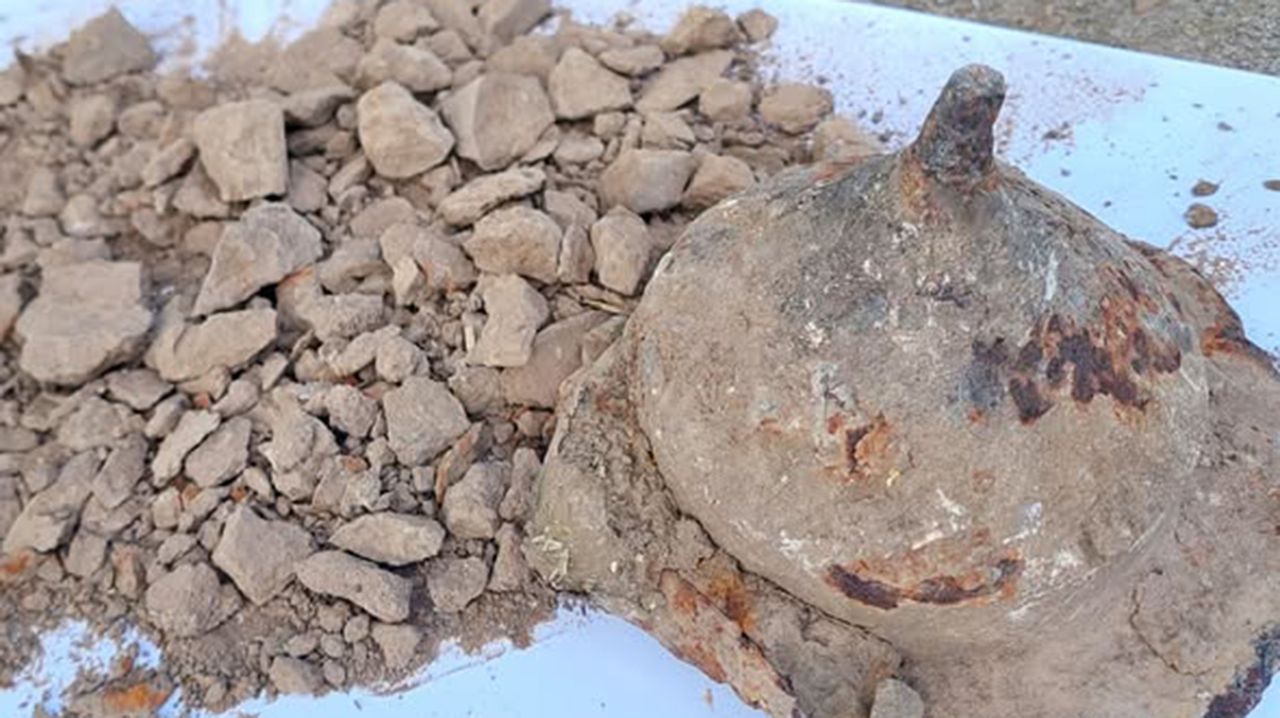
An iron shield boss discovered in a junkyard in southeastern Poland contained cremated bones, according to archaeologists at the Father Stanisław Staszic Museum in Hrubieszów. The find may be part of a Vandal warrior’s burial dating to the second century, although the original grave has been destroyed or lost.

The artifact was found earlier this month by a man searching for spare automobile parts at a junkyard in Hrubieszów, near Poland’s border with Ukraine. After recognizing that the object might be ancient, he sent a photograph to the museum. Archaeologists subsequently examined the find and identified it as the central iron fitting of a shield, known as a boss or umbo.

A shield boss protected the hand and supported the wooden and leather components of the shield. Those organic parts have decayed, leaving only the iron central section. A plug of dried earth inside the boss was found to contain cremated bone fragments.

The museum said the boss’s preservation and distinctive surface indicate that it had been exposed to high temperatures. Combined with the burned bones, this evidence led the archaeologists to conclude that the object was associated with a cremation burial of a warrior from the Vandal community.

The identification remains an archaeological interpretation rather than a recovery from an intact grave. The find’s location, its pointed form and the second-century dating are consistent with a Vandal origin, according to the reporting. The source also notes that the Romans used shield bosses, but archaeologists do not believe Roman legionaries reached this part of Poland.

The Vandals were a Germanic people associated in Poland with the Przeworsk culture. Their burial customs included cremation. However, because the original burial site has been disturbed, researchers cannot determine what other objects may have accompanied the deceased. Possible missing items include a sword, spearheads, javelins, a belt buckle or a cloak clasp, according to the museum team.

The discovery therefore preserves only a small part of a burial assemblage: an iron shield fitting and the cremated remains held within its earth-filled interior. The rest of the grave’s contents, if any survived, are no longer known.

Reference Desk

Sources & Further Reading

Continue Exploring

Related Archaeology

More stories
Study Examines Unusual 17th-Century Burial in Pień, Poland
01
Discoveries
Score 65

Study Examines Unusual 17th-Century Burial in Pień, Poland

A multidisciplinary study of Grave 75 at a cemetery in Pień examines the remains of a woman who died at about 17–19 years old. A sickle placed across her neck and a padlock fixed to her toe suggest measures intended to prevent the dead from returning, although researchers frame the burial within historical beliefs and social fears.

Read story
Domestic Buildings and Workshops Found Near Memphis Temple
02
Ancient Civilizations
Score 20

Domestic Buildings and Workshops Found Near Memphis Temple

A joint Egyptian-Chinese team has uncovered adobe buildings, workshops, and a possible winepress near the Temple of Sekhmet in Memphis. Ceramics, faience amulets, and votive plaques may indicate that religious activity continued there into the Greco-Roman period.

Read story
Inner-Ear Bone Study Traces Population Change in Prehistoric Northeast Africa
03
Human Origins
Score 20

Inner-Ear Bone Study Traces Population Change in Prehistoric Northeast Africa

An analysis of bony labyrinths from 148 prehistoric and recent individuals identifies continuity among Middle Nile Valley foragers but a marked morphological break after the emergence of Neolithic food-producing communities. The results also point to substantial population diversity and possible isolation across northeastern Africa.

Read story
Study Finds La Mojana Raised Fields Could Have Been Built Cooperatively
04
Discoveries
Score 20

Study Finds La Mojana Raised Fields Could Have Been Built Cooperatively

An analysis of pre-Hispanic canal-and-ridge systems in Colombia’s La Mojana suggests that a 500-hectare network could have been constructed by local communities within one dry season. The findings challenge the assumption that landscapes covering more than 500,000 hectares required centralized political control.

Read story
Roman Shipwreck Carrying Hundreds of Amphorae Found off Sicily
05
Underwater Archaeology
Score 20

Roman Shipwreck Carrying Hundreds of Amphorae Found off Sicily

Italy’s Carabinieri cultural heritage protection unit has located a Roman shipwreck about three miles off Mazara del Vallo, Sicily. The approximately 2,100-year-old vessel contains around 500 amphorae, along with parts of anchors, and will undergo further scientific documentation.

Read story
Virtual Hunting Study Tests How Easily Fallow Deer Could Be Seen
06
Discoveries
Score 20

Virtual Hunting Study Tests How Easily Fallow Deer Could Be Seen

Two online visual-search experiments examined how fallow deer coat patterns, distance and body orientation affected human detection in a simulated Pleistocene woodland. The results may help interpret proposed projectile lesions on deer bones in the archaeological record.

Read story