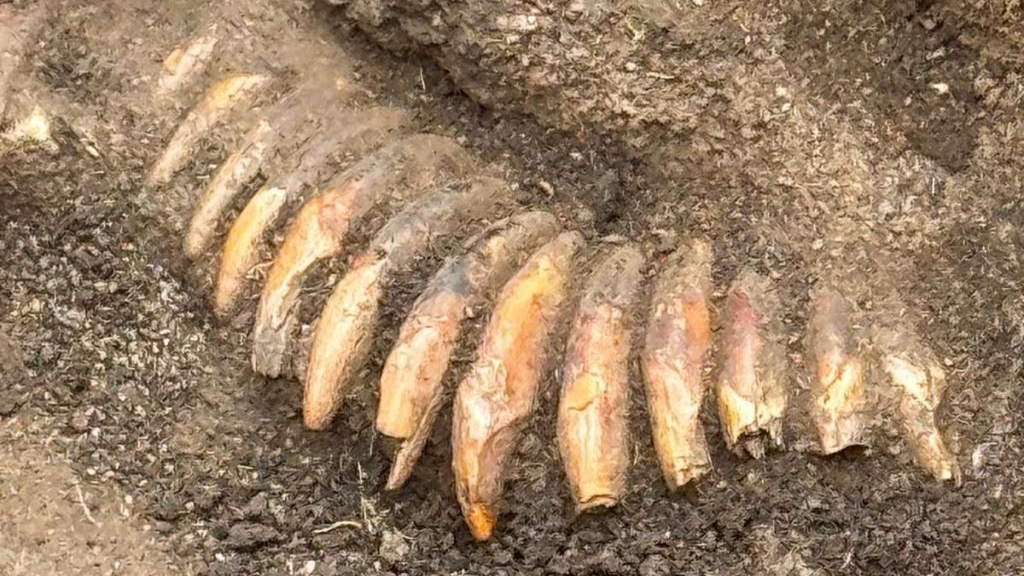
A Stone Age burial discovered near Wrocław in southwest Poland has been found to contain a possible tooth necklace, a battle ax and the remains of two human skulls. The grave was uncovered during excavations at a cemetery from the Roman period, but the burial is estimated to be about 3,000 years older.
The nearly complete skeleton belonged to an adult man. Objects placed with him included amber beads, a flint blade and a battle ax made from serpentinite, a greenish metamorphic rock. Based on the style of the ax, archaeologists date the grave to around 2900 B.C., during the Middle Neolithic.
The burial’s most unusual feature was a carefully arranged group of 42 mammal teeth. All had holes drilled through their roots, indicating that they were probably strung together as a necklace. The teeth included incisors and canines from large mammals such as wolves, deer and bears. Researchers said some may potentially have come from humans, although the material does not establish that identification.
The grave also contained remains from two human skulls. Archaeologists think these could be decapitated heads placed in the burial as gifts or funeral offerings, but further analysis is needed to confirm or rule out decapitation. An ax was found beneath the man’s right elbow.
Paweł Dąbrowski, a biological anthropologist at Wrocław Medical University, said the necklace and the other grave goods could indicate that the buried individual was important. The researchers suggested he may have been a warrior or hunter, or possibly a leader of a family clan, but these interpretations remain tentative.
The team said the burial may be associated with the Corded Ware culture, which is described in the source material as likely having helped spread Indo-European languages across Europe and Asia. A similar nearby burial contained axes, flint tools, amber beads and calf bones that may indicate an animal sacrifice. Researchers said these are currently the only two burials of this type known in the area.
Next, archaeologists plan to analyze the remains from both Stone Age graves to investigate whether the individuals were related and to learn more about their lives. Initial results are expected later this year.